
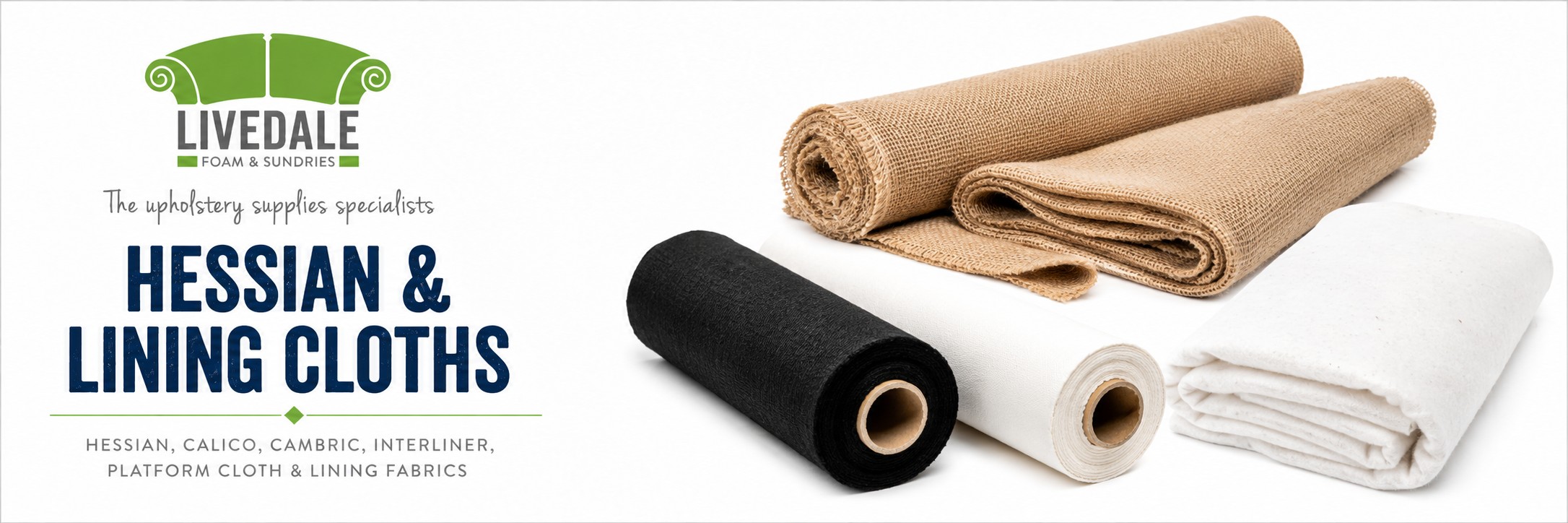
Upholstery Hessian and Lining Cloths for Furniture Making
Shop upholstery hessian and lining cloths for furniture manufacturing, traditional upholstery, reupholstery, cushion making and repair work. Livedale supplies natural hessian, linen scrim, platform cloth, base cloth, Corovin, calico, cambric, interliners, needle punch fabric, stretch polyester and anti-slip cloth for professional upholsterers, furniture makers and experienced DIY customers.
These materials are used throughout the internal construction and finishing of upholstered furniture. Some create a foundation over springs or webbing, while others separate upholstery layers, cover platform areas, form cushion interiors or provide a clean finish beneath chairs and sofas.
Choosing the correct cloth depends on where it will be used and what it needs to do. A strong hessian used over upholstery springs performs a very different job from lightweight black base cloth fitted beneath a finished chair. Likewise, waxed cambric, anti-slip cloth and stretch polyester each serve distinct purposes and should not be treated as interchangeable lining fabrics.
Shop Hessian and Upholstery Lining Cloths
The range is divided into two principal categories:
Hessian covers traditional natural woven materials used within furniture construction and restoration. Platform & Base Cloth contains the modern and traditional lining fabrics used across platforms, cushion interiors, furniture undersides and concealed upholstery areas.
Upholstery Hessian
Browse our range of upholstery hessian for traditional furniture upholstery, spring covering, stuffing work, stitching, lining and decorative projects.
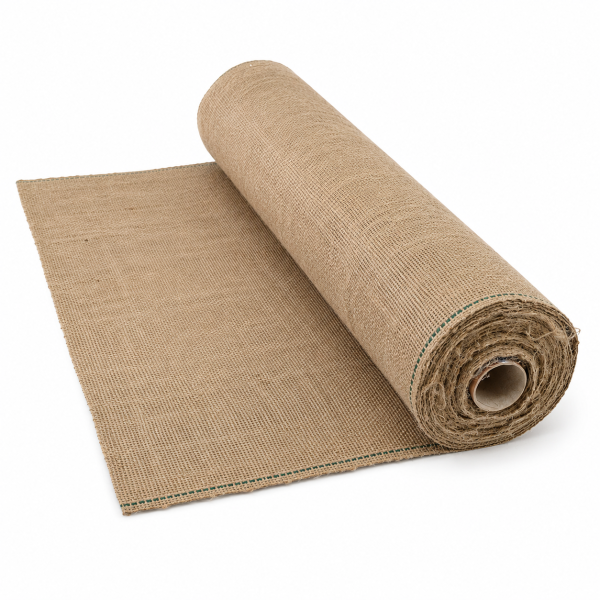
Hessian is a coarse woven natural material, also commonly called burlap. It has been used in furniture making for generations because it is practical, breathable and available in different weights for different upholstery tasks.
The current range includes lightweight and heavyweight natural hessian, wide hessian cloth, coloured hessian and natural linen scrim.
Choosing the Correct Hessian Weight
Hessian weight is commonly stated in ounces. The weight influences the thickness, strength and handling of the cloth.
A lighter hessian may be suitable for lining, covering fillings or less heavily loaded furniture sections. A heavier cloth may be more appropriate where greater strength is required, such as over springs or across a supporting furniture section.
The correct choice depends on:
- Whether the material will cover springs, webbing or fillings
- The amount of load placed on the furniture section
- The spacing between the supporting components
- Whether the hessian will be stitched or tacked
- The condition and construction of the furniture frame
- Whether the project uses traditional or modern upholstery methods
Do not select hessian solely by choosing the heaviest available grade. A very heavy cloth can be unnecessarily difficult to shape around detailed furniture sections, while a lightweight grade may not provide sufficient strength for a heavily loaded seat.
Check the individual product description and match the weight to the intended application.
Lightweight Hessian
Lighter hessian can be used for general lining, stuffing work and suitable furniture sections where the cloth is not expected to carry the main seating load.
It is easier to handle around shaped frames, backs and arms and can provide a useful layer between upholstery components.
Lightweight hessian should not be relied upon as a substitute for strong spring canvas where the material will be stretched tightly over springs or heavily loaded support areas.
Medium and Heavy Hessian
Medium and heavier hessian grades are used where a stronger traditional upholstery cloth is required.
Potential applications include covering suitable springs, forming a foundation above webbing or spring systems, supporting traditional fillings and closing furniture sections before later upholstery layers are applied.
When hessian is fitted over springs, it should be tensioned evenly and secured to a sound frame. It may also be stitched to the spring system using an established upholstery method to reduce unwanted movement.
The hessian does not replace the springs or webbing beneath it. Those components provide the principal structural support, while the hessian helps distribute the upholstery layers and create the foundation above them.
Wide Hessian Cloth
Wide hessian can be useful for larger chairs, sofas, headboards and furniture sections where avoiding unnecessary joins is desirable.
Before ordering, compare the material width with the widest part of the section being covered. Allow sufficient additional material for tensioning, turning and fixing around the frame.
A width that only just matches the visible area will normally be insufficient once the material has to wrap over the furniture rails.
Natural Linen Scrim
Natural linen scrim provides another traditional woven material for suitable upholstery, lining and craft applications.
Its fibre and weave differ from standard jute hessian, so it should be selected according to the particular furniture method and product specification rather than treated as an automatic substitute.
Linen scrim can be useful where a strong natural woven cloth is required but the exact application should be checked before ordering.
Coloured Hessian
Coloured hessian provides a more decorative alternative to natural brown upholstery hessian.
It can be used for display work, crafts, event decoration, notice boards, retail presentation and creative furniture projects where the material may remain visible.
Coloured hessian is primarily selected for appearance and should not automatically be assumed to provide the same strength or performance as a heavier natural upholstery grade.
Where it will form part of a furniture construction, check the weight, width and intended use carefully.
Platform and Base Cloth
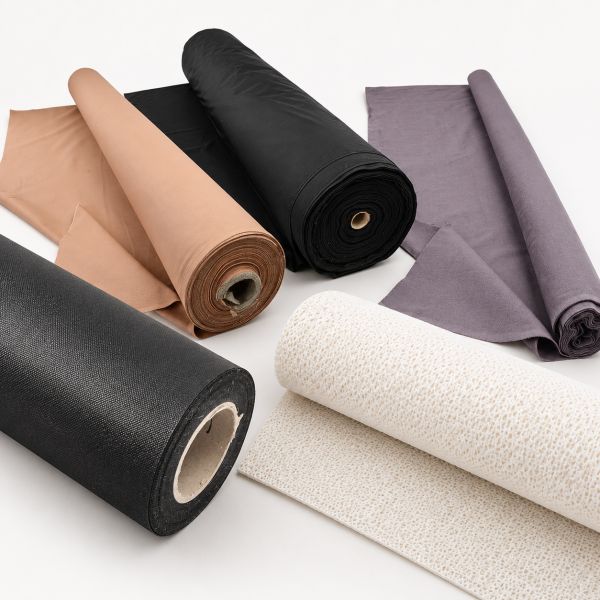
Browse platform and base cloth for covering furniture platforms, lining concealed areas, making cushion interiors and finishing the undersides of chairs, sofas and other upholstered items.
This section contains six more specialised categories:
- Anti-Slip
- Base Cloth and Corovin
- Calico, Interliner and Cambric
- Needle Punch
- Platform and Lining Cloths
- Stretch Polyester
These materials may appear similar when seen on a roll, but their construction and intended uses differ considerably.
Anti-Slip Cloth
Browse anti-slip cloth for helping reduce the movement of loose seat cushions, mattresses and suitable upholstered components.
Anti-slip cloth has a grip surface designed to create additional friction between the cushion and the furniture platform beneath it.
It can be used:
- Beneath loose sofa and chair cushions
- On the underside of suitable cushion covers
- On campervan and motorhome seating
- Beneath mattresses or seat pads
- On furniture where repeated cushion movement is a problem
Anti-slip cloth can reduce movement, but it cannot always eliminate it entirely. Cushion shape, furniture angle, cover tension, user movement and the condition of the platform can all influence how securely a cushion remains in place.
The cloth should be fitted smoothly without deep folds or loose areas. Where it is being sewn into a cushion cover, allow for seams and make sure the grip surface faces the furniture platform.
Base Cloth and Corovin
Browse base cloth and Corovin for finishing the underside of furniture, lining concealed areas and making suitable inner covers.
The range includes black and white Corovin or Dipryl together with woven polypropylene base cloth.
Corovin is a lightweight non-woven synthetic material that is easy to cut and staple. It is widely used where an economical and tidy concealed finish is required.
Black Furniture Base Cloth
Black base cloth is commonly fitted to the underside of sofas, chairs, footstools and other upholstered furniture.
It helps:
- Conceal the internal frame and upholstery components
- Reduce the entry of dust and debris
- Provide a neat finished appearance
- Cover access openings beneath the furniture
- Complete the underside after repair or reupholstery
Base cloth is a finishing material rather than a structural support fabric. It should not be stretched across an open frame and expected to support springs, webbing, cushions or the weight of a user.
Fit it with enough tension to remove wrinkles without pulling so tightly that the cloth distorts or tears around the staples.
White Corovin and Dipryl
White Corovin or Dipryl can be used for suitable cushion interiors, lining applications and concealed furniture sections where a pale material is preferred.
It may be selected for inner cases, cushion ticks or other light-duty lining work, subject to the particular product specification.
Where the cloth will contain loose filling, check that its construction is sufficiently close and strong for the material inside. Fine feather, fibre and foam crumb can place very different demands on an inner case.
Woven Polypropylene Base Cloth
Woven polypropylene base cloth provides a stronger synthetic option for suitable underside and platform applications.
Its woven construction differs from lightweight non-woven Corovin. It may be chosen where greater resistance to tearing or more substantial handling is required.
Check the width and intended use before substituting one type of base cloth for another.
Calico, Interliner and Cambric
Browse calico, interliner and cambric for traditional upholstery, furniture lining, cushion interiors and specified fire-barrier applications.
Although grouped together for convenient shopping, these materials perform quite different jobs.
Natural Calico
Calico is a plain woven cotton cloth used extensively in upholstery and furniture making.
It can be used:
- As a lining beneath the final upholstery fabric
- To cover and contain traditional fillings
- As an intermediate upholstery layer
- For making patterns or trial covers
- For covering concealed furniture sections
- As a strong natural workroom cloth
A calico lining can provide a cleaner and more controlled foundation beneath the final cover. It can help contain fillings, reduce direct abrasion between layers and make later reupholstery easier because the internal work remains more orderly.
Calico is available in different widths and weights. Check the individual product before assuming that one grade is suitable for every upholstery task.
Waxed Cambric
Waxed cambric is used for feather cushion interiors and other applications where a closely woven lining is required to help reduce feather migration.
The waxed finish helps create a smoother and more resistant barrier than an ordinary open-weave lining cloth.
It may be used for:
- Feather seat cushion interiors
- Feather back cushions
- Feather and down scatter cushions
- Suitable loose-filling inner cases
- Repairing or replacing existing featherproof ticks
The material must still be cut and sewn carefully. Needle size, thread, seam construction and stitch length all affect how successfully the completed case contains the filling.
Repeated unpicking can leave unnecessary needle holes, so test the sewing-machine settings on an offcut first.
Upholstery Interliners and Barrier Cloths
Interliners are used as an additional layer between the outer cover and upholstery fillings in specified furniture constructions.
The Livedale range includes products described as Schedule 3 Crib 5 interliner barrier cloth and barrier felt.
An interliner should only be selected after considering:
- The type of furniture being made or reupholstered
- The outer covering material
- The fillings and other upholstery components
- The intended domestic or commercial environment
- The test evidence supplied for the exact interliner
- The complete furniture construction
- Current legal and project-specific requirements
Using an interliner does not, by itself, provide a blanket guarantee that the completed furniture will comply with every fire-performance requirement.
The furniture manufacturer, upholsterer, specifier or supplier remains responsible for ensuring that the finished item and complete material combination meet the requirements applying to that project.
Retain the relevant product documentation and test information where compliance must be demonstrated.
Needle Punch Fabric
Browse needle punch fabric for furniture lining, base covering, platform areas and other concealed upholstery applications.
Needle punch is a non-woven material manufactured by mechanically interlocking fibres. It is available in different weights, colours and widths.
Potential uses include:
- Furniture base cloth
- Platform lining
- Covering concealed furniture sections
- Mattress and bedding components
- Furniture manufacturing
- Protective separation between upholstery layers
Its non-woven construction helps reduce fraying and can make the material quick to cut and fit in production environments.
The available weight should be matched to the intended use. A heavier needle punch fabric may provide greater body and tear resistance, while a lighter grade may be adequate for straightforward concealed covering work.
Needle punch should not be confused with structural webbing or spring-support material. It covers, lines and separates components but does not replace a properly constructed furniture support system.
Platform and Lining Cloths
Browse platform and lining cloths for covering the fixed deck or platform beneath loose furniture cushions.
The range includes cotton and poly-cotton platform cloths in several colours and widths.
Platform cloth is normally visible when the loose seat cushions are removed. A coordinated colour and neatly fitted finish therefore contribute to the overall quality of the furniture.
It can be used to:
- Cover the fixed seating platform
- Create a clean surface beneath loose cushions
- Conceal foam, felt or other upholstery layers
- Line suitable furniture sections
- Finish the underside of non-reversible cushions
- Coordinate with the outer upholstery cover
Cotton Platform Cloth
Cotton platform cloth provides a traditional woven option with a natural feel and appearance.
It may be selected for higher-quality furniture, restoration work and projects where a natural woven platform material is preferred.
Cotton cloth can fray at cut edges, so edges may need to be turned, overlocked or securely concealed according to the construction method.
Poly-Cotton Platform Cloth
Poly-cotton combines cotton and synthetic fibres to create a practical upholstery lining material.
It can provide easy handling, consistent appearance and useful durability for furniture production and reupholstery.
The exact fibre composition, weight and width should be checked on the individual product page.
Choosing the Platform Cloth Colour
Platform cloth is commonly offered in neutral shades such as black, brown, beige and fawn.
Choose a colour that works with the outer upholstery fabric and is unlikely to appear distracting when the seat cushions are removed.
A closely coordinated colour is not always necessary, but a sharp contrast can make an otherwise well-upholstered piece look unfinished.
Stretch Polyester
Browse stretch polyester for covering curved platforms, shaped furniture sections and areas where a rigid woven cloth may crease or resist fitting.
Its flexibility allows it to follow contours and corners more easily than a non-stretch lining material.
Potential applications include:
- Curved furniture platforms
- Shaped arms and backs
- Concealed lining areas
- Undersides of suitable cushions
- Furniture sections requiring a close-fitting synthetic cloth
- Hook-and-loop receptive applications where specified
Stretch polyester should be tensioned evenly. Pulling too heavily in one direction can distort the material, create uneven coverage or alter the shape of a soft furniture section.
Do not assume that every stretch fabric stretches equally in every direction. Test the cloth before cutting and orientate the stretch according to the shape being covered.
Hook-and-Loop Receptive Cloth
The Stretch Polyester category also includes hook-and-loop receptive cloth.
This material can be used where a compatible hook fastening needs to attach directly to the surface of the lining cloth.
It may be useful for removable furniture panels, adjustable components, cushions and other suitable upholstery applications.
Check compatibility with the hook component before producing the finished item. Not every hook tape provides the same level of grip on every receptive fabric.
Hessian, Platform Cloth or Base Cloth?
The correct cloth depends primarily on its location within the furniture.
Use upholstery hessian where a strong woven natural foundation or traditional upholstery layer is required.
Use platform cloth on the fixed seating deck beneath loose seat cushions.
Use black base cloth or Corovin to finish the underside of a chair, sofa or footstool.
Use calico as a natural intermediate lining, filling cover or traditional upholstery layer.
Use waxed cambric for suitable feather cushion interiors.
Use anti-slip cloth where loose cushions or mattresses require additional grip.
Use needle punch for practical concealed lining and base-covering applications.
Use stretch polyester where the lining must follow curves, contours or shaped furniture sections.
Use a tested interliner only as part of a considered furniture construction where its specification and documentation are suitable for the project.
Structural Support and Upholstery Linings
It is important to distinguish between furniture support materials and furniture lining materials.
The principal structural support beneath a seat normally comes from components such as:
- Upholstery springs
- Spring units
- Zigzag springs
- Elasticated webbing
- Jute webbing
- Rubber webbing
- Timber or board platforms
Hessian may form a strong foundation above some of these components, but lightweight platform cloth, Corovin, needle punch and ordinary base cloth are not intended to carry the weight of a seated person.
A lining material can contribute to an orderly, durable upholstery construction without being the part that provides the structural support.
When repairing sagging furniture, inspect the springs, webbing and frame before assuming that replacing the visible lining cloth will solve the problem.
Measuring Upholstery Cloth
Most hessian and lining materials are sold by the linear metre, with the full roll width supplied across each metre ordered.
Always check the width shown on the product page. The current range includes several different widths, so one metre of one cloth may provide a very different usable area from one metre of another.
Before ordering, measure:
- The maximum width of the furniture section
- The maximum depth or length
- The amount needed to turn around frame rails
- Tacking or stapling allowance
- Seam allowance where the cloth will be sewn
- Additional material for pattern positioning
- The number of identical furniture sections
- Any allowance for mistakes or future repair
For a chair or sofa base, measure the complete fixing area rather than only the visible opening.
For a platform, include the material needed to pass beneath piping, facings or adjoining furniture sections.
For cushion interiors, create a complete cutting plan including top, bottom, border and seam allowances.
Ordering by the Metre or Full Roll
Cut lengths are practical for one-off repairs and smaller upholstery projects. Full rolls may be more appropriate for furniture manufacturers, professional workrooms and repeated production.
Before ordering a full roll, confirm:
- Roll width
- Approximate roll length
- Material weight
- Colour
- Product construction
- Intended use
- Storage space
- Whether all work should be completed from one batch
Natural cloths can contain minor variations in colour and weave. Synthetic materials can also show small batch differences.
Where several pieces of matching furniture are being produced, ordering the required quantity together can help maintain consistency.
Cutting Hessian and Lining Cloth
Use sharp upholstery shears or a suitable knife and cutting surface.
Hessian and woven cloths can fray after cutting. Handle the edges carefully and allow enough material for them to be turned or securely fixed.
A useful approach is to mark the cloth using a removable upholstery chalk before cutting. Test any marking product on a waste section, particularly on pale lining materials.
When cutting:
- Keep the weave reasonably square to the furniture
- Avoid pulling individual threads before measuring
- Allow for fraying
- Cut away from the finished furniture
- Support wide material to prevent it dragging
- Keep directional stretch or surface texture consistent
- Label repeated panels where several sections look similar
Natural hessian can shed loose fibres during cutting. Keep the workroom clean so these do not become trapped beneath the final upholstery fabric.
Fitting Hessian to a Furniture Frame
The frame should be sound, clean and free from protruding broken staples or tacks before new hessian is fitted.
Position the cloth squarely and establish even tension gradually. Secure opposing sides in stages rather than completely fixing one edge and then attempting to pull the entire cloth from the other side.
Depending on the furniture and upholstery method, hessian may be secured using suitable upholstery tacks or staples.
Avoid fastening too close to a frayed edge. Leave enough material beyond the fixing line to resist pulling through.
Where the hessian covers traditional springs, follow an established spring-covering and stitching method. Uneven tension or poorly secured hessian can move against the springs and affect the later upholstery layers.
Fitting Platform and Base Cloth
Platform cloth should be aligned carefully because it can remain visible beneath removable cushions.
Keep seams, edges and fixing lines straight. Where adjoining panels meet, plan the join so it sits in the least conspicuous and least heavily worn position.
Base cloth fitted beneath furniture should be neat but not excessively tight.
Work from the centre of each side towards the corners, maintaining enough tension to remove loose wrinkles. Fold or trim corners cleanly so they do not hang beneath the furniture.
Before closing the underside, check that:
- All internal repairs are complete
- Loose staples and tacks have been removed
- Springs and webbing are secure
- No tools remain inside the furniture
- Required labels are fitted
- Mechanisms and moving components remain accessible
- The cloth will not rub against sharp or moving parts
Closing the base before checking the internal work is a splendid way of discovering one forgotten staple five minutes after the final corner has been finished.
Sewing Cushion Linings and Inner Cases
Calico, cambric, Corovin and other lining fabrics can be used in sewn cushion components where the particular cloth is suitable for the filling.
Choose:
- A suitable sewing thread
- The correct needle size and point
- A secure seam construction
- An appropriate stitch length
- A zip or closing method suitable for the filling
- A cloth dense enough to contain the interior material
Feather interiors place particular demands on seams and needle holes. Waxed cambric should be sewn accurately, with unnecessary unpicking avoided.
Loose fibre and foam crumb can also work into weak seams if the inner case is overfilled or handled roughly.
Test the completed seam before filling a large cushion batch.
Fire Performance and Upholstery Interliners
Furniture fire performance depends on the complete item, not one material considered in isolation.
The outer cover, interliner, fillings, construction and intended market may all affect the requirements applying to the finished furniture.
Where an interliner is being used:
- Check the current test certificate
- Confirm the exact product reference
- Establish which side faces the cover where relevant
- Follow the specified construction method
- Retain batch and supplier information
- Consider the outer cover and fillings
- Confirm the requirements for the furniture’s intended destination
- Keep appropriate technical records
Do not describe a completed item as compliant solely because a product called a Crib 5 or Schedule 3 interliner has been included.
Where there is uncertainty, obtain competent testing or compliance advice before placing the furniture on the market.
Related Upholstery Materials
Hessian and lining cloths are normally used alongside other furniture-making materials.
Browse upholstery springs and webbing for the support systems fitted beneath hessian and furniture platforms.
Explore upholstery staples and tacks for securing hessian, platform cloth and base materials to suitable timber frames.
Our professional upholstery tools include shears, knives, tack hammers, staple guns, tack lifters and other workroom equipment.
Browse foams and fillings for cushion foam, polyester wadding, felt, feather, fibre and loose upholstery fillings.
Our workroom supplies include sewing threads, twines, adhesives, zips, fire labels and other furniture-making essentials.
Trade Upholstery Hessian and Lining Cloths
Livedale supplies upholstery hessian, platform cloth, Corovin, calico, cambric, interliners, needle punch and base cloth to professional upholsterers, furniture manufacturers, cushion makers, repair workshops and other trade customers throughout the UK.
Approved trade customers can access preferential trade pricing across eligible products after registering for a trade account.
Browse the categories above to find the correct hessian or lining cloth for your next furniture manufacturing, repair or reupholstery project.